Matter-annihilation instrument
Last and First MenThe Matter-annihilation instrument is a rifle-like device that can initiate the annihilation of matter at a distance, direct it toward a chosen point, and halt its spread. Its demonstration turns an apparently manageable scientific tool into a force capable of destroying an island and an air fleet; its destruction follows from the realization that neither scientific expertise nor good intentions can make such power safe in the hands of a divided world.
Design and Claimed Uses
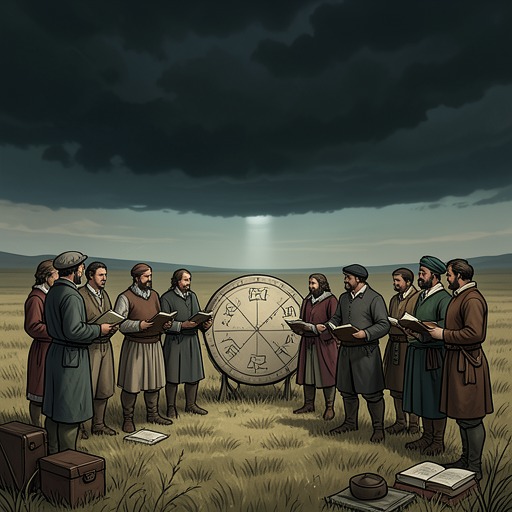
The young Chinese scientist brings the instrument to a scientific society in a case. Its resemblance to an old-fashioned rifle gives its extraordinary operation an immediately legible form: it can be aimed, and its user controls it through triggers. The scientist describes two distinct capabilities. One trigger initiates matter’s annihilation at a chosen point; a second inhibits the process. The instrument is therefore not simply a source of destructive force but a device for directing and stopping that force.
The scientist presents destruction as a demonstration of the instrument’s wider importance. He claims that it can annihilate matter at a distance and in a precise direction, while another instrument he expects to perfect will provide unlimited industrial power wherever it is needed. He imagines organized intelligence using these devices to end war and govern the planet. The society, however, must judge the instrument not by this promised future but by what its present, finished form can do. Its power to stop annihilation depends on a user intervening correctly after setting the process in motion.
Demonstration at Lundy Island
To demonstrate the instrument, the scientist selects Lundy Island, which he describes as uninhabited and a danger to shipping. He explains that the device will stimulate positive and negative charges in the atoms at one point on the rock face. The resulting annihilation will spread to neighboring atoms unless he uses the second trigger to stop it. He warns that without that intervention, the process might continue until the planet itself disintegrated.
After taking careful aim, he presses the triggers in quick succession. There is initially no visible change, but a point of light appears on the distant cliff and grows until the island’s end facing the mainland is intensely illuminated. Steam rises from the boiling sea; then the three miles of granite break apart, sending rocks upward beneath a vast cloud of steam and debris. The delayed sound reaches the spectators after the island has split. A great wall of water follows, engulfs a coasting vessel, and travels toward Bideford and Barnstaple. The scientist watches with exultation and some surprise at the scale of the effects. The demonstration establishes that even a controlled use can carry consequences beyond the precise point at which the instrument is aimed.
Use Against the American Air Fleet
The society later confronts the instrument’s military use when an American air fleet approaches. The scientist has agreed to abide by the meeting’s decision, but, after studying the western sky through a field-glass, he identifies the incoming aircraft as American. The fleet’s approach changes the question from whether the device should exist to whether it should be used to prevent an imminent attack. The English representative urges him to act, while the American representative acknowledges that his own people, including his son, may be among the airmen and nevertheless asks that the fleet be stopped.
With the society’s president’s assent, the scientist aims at each dark aircraft in turn. Each becomes a point of intense light and vanishes. The French representative is the sole protester, and the destruction is followed by silence and by anxious, hostile looks toward the scientist. The scene confirms the instrument’s precision as a means of striking distant targets, but it also reveals the limits of that precision as a moral safeguard: the machine can select targets, yet the decision to use it remains a collective choice made under the pressure of war.
Destruction and Significance
Before the attack on the fleet, the society had voted unanimously that the instrument and every account of its operation should be destroyed. Its members disagree over whether refusing the device is cowardice or prudence, but the final decision treats the risk of entrusting it to existing political powers as decisive. The subsequent use against the fleet does not reverse that judgment. Instead, it demonstrates how quickly the instrument can be made indispensable in a crisis, even by people who have already recognized its danger.
After the fleet is destroyed, a fire is lit in a neighboring field, and both the instrument and the manuscript that records its process are burned. The inventor insists that his secret cannot remain alive in him and dies after declaring himself a danger to the planet. The destruction is thus intended to remove both the working object and the knowledge needed to reproduce it. Yet the scientist predicts that a more worthy race may rediscover the process. The instrument’s ending is therefore not a resolution of the danger so much as an attempt to postpone its return. In its short passage from case, to demonstration, to weapon, and finally to fire, a tool conceived as a means of ending conflict exposes how fragile the boundary is between organized intelligence and catastrophic power.